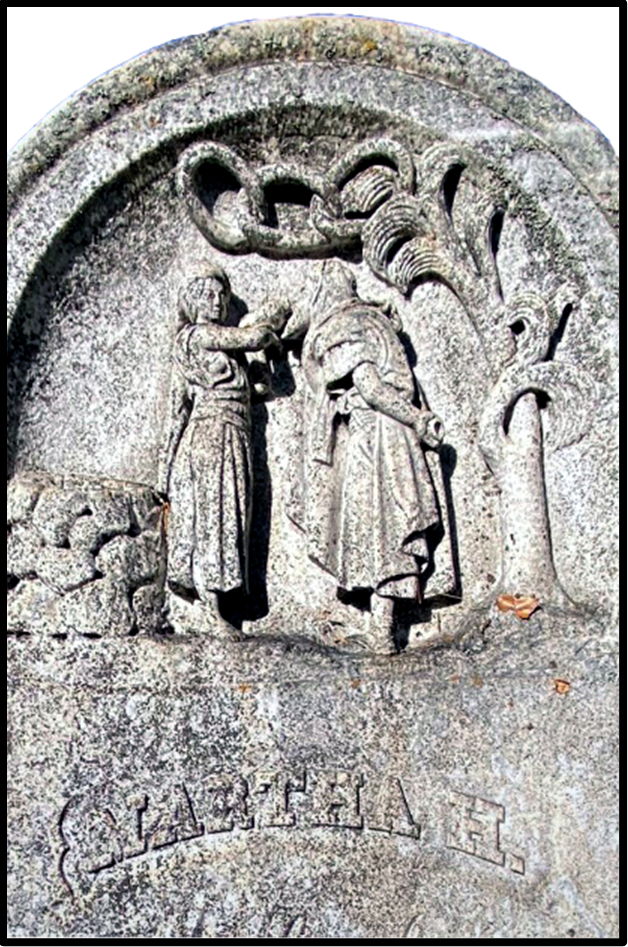
The story of the woman at the well is one of the most iconic encounters in the Bible. It depicts Jesus meeting a Samaritan woman at a well and asking her for a drink of water. The ensuing conversation leads to her acceptance of a Jewish God.
The encounter was unusual because Jews and Samaritans did not normally mix, and also because the woman was supposedly on husband #5.
At the time, women typically went to the well in groups each morning as a social occasion. Her marriage history, combined with the fact that she was drawing water alone at midday, suggests she was an outcast.
Scholars think this may be Jesus’ first declaration that He was the Messiah. This story is significant not only for Jesus’ early proclamation, but for who He made it to; a woman of low standing – gender, race, and marital history.
What this might have to do with young Martha Lequerhic, who died at age 27, is anyone’s guess… and guess we will… but first some background:
Martha widowed a 45-year-old Frenchman Charles, who must have loved her dearly to commission such an intricate carving. Charles’ adjacent headstone sits on a large base, oddly emblazoned with the word “YVES,” which might be a clue to the significance of the woman at the well.
Yves is a cultural region in Northwest France, named for a 13th century saint venerated for his commitment to justice and concern for the marginalized and vulnerable… people like the woman at the well. Saint Yves’ advocacy for the underprivileged extended famously into the courts, so much so that the Church named him Patron Saint of Lawyers. His teachings continue to inspire legal professionals and activists.
Best guesses of the significance, if any, of the woman at the well:
1. Charles commissioned the headstone depicting Jesus engaging an outcast to honor Saint Ives’ commitment to the poor and disenfranchised. Perhaps Martha was similarly sympathetic to the needs of the less fortunate.
2. Charles hailed from Yves and simply carried his home region onto his tombstone. Martha’s headstone carving was an unrelated bible scene.
3. Charles was a lawyer who honored his patron saint on his tombstone, again unrelated to the carving on his wife’s headstone.
Interpretation by Mike Roberts, 2024
SaveTheGravesElDorado.org